
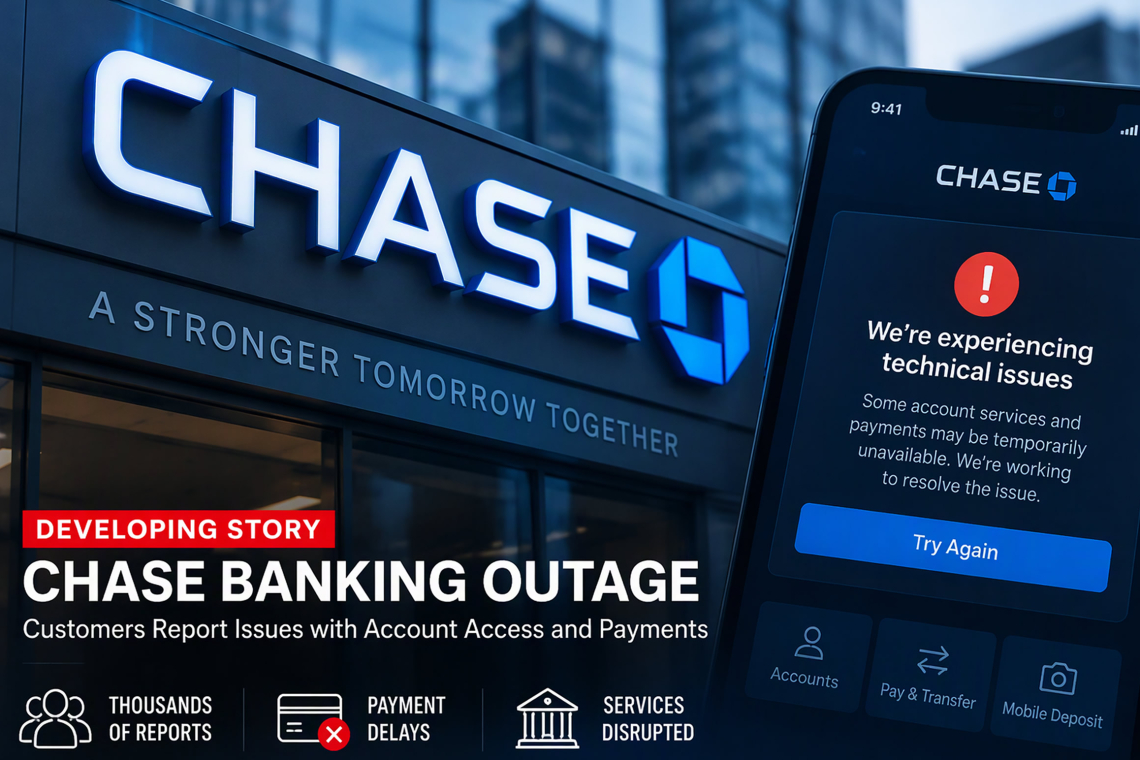
A software malfunction at JPMorgan Chase triggered widespread banking disruptions on November 16, 2026, preventing thousands of customers from accessing accounts, processing payments, and completing routine transactions. At the height of the incident, users across social media and outage-tracking platforms reported difficulties with Chase services, while complaints also surfaced involving Bank of America, Wells Fargo, U.S. Bank, and the digital payments network Zelle. Despite the volume of reports, there was no indication that each institution experienced an independent outage.
According to Chase, the disruption stemmed from a temporary software defect affecting the bank’s internal, on-premises computing infrastructure. The company emphasized that the issue originated within its own hardware environment and was not the result of malicious cyber activity. Bank officials stated that the problem was isolated to specific systems and did not represent a broader failure across the U.S. banking sector.
Throughout the outage, customers encountered a range of service interruptions. Many were unable to check account balances, review recent transactions, transfer funds, or complete digital banking activities. Some users also experienced difficulties accessing cash withdrawals, while transaction processing delays affected both branch operations and online banking channels. Although Chase maintained that customers’ funds remained secure and accessible, processing times for certain transactions were significantly longer than normal.
Ripple Effects Extended Beyond Chase
Much of the confusion surrounding the incident arose because delays spread to transactions involving other financial institutions. Chase explained that payments routed through its systems could experience interruptions or slower processing, creating the appearance of outages at multiple banks. However, several institutions clarified that their own banking infrastructure remained fully operational.
Bank of America and Citigroup both indicated that their services were functioning normally and that they were not experiencing direct technical failures. Likewise, U.S. Bank stated that its internal systems had not been impacted, although some customers might encounter delays when interacting with accounts or payment services connected to Chase.
The same distinction applied to Zelle, which saw increased reports of delayed transfers during the disruption. While users associated the delays with the payment platform itself, Zelle stated that its network continued to operate normally. Its parent company, Early Warning Services, noted that payment delays were linked to issues occurring at participating financial institutions rather than within the Zelle network. As a result, customers attempting to send money to a Chase account or receive funds from a Chase customer through another bank could experience transaction delays even if their own financial institution was unaffected.
No Evidence of a Cyberattack
Available information suggests the outage was caused by a technology failure rather than a cybersecurity incident. Reports indicated the disruption was connected to a software update affecting Chase’s physical computing systems. While the bank publicly attributed the event to a software bug, it did not disclose which component failed or provide detailed technical information regarding the root cause.
This distinction is significant because banking outages are often associated with cyber threats such as distributed denial-of-service (DDoS) attacks, ransomware operations, or other forms of targeted disruption. In this case, Chase stated that investigators found no evidence pointing to external interference, malicious actors, or unauthorized access. The outage also occurred shortly after a separate Microsoft 365 service disruption, though there is currently no evidence linking the two incidents.
Services Gradually Returned to Normal
By Monday evening, Chase reported that affected transactions were once again processing normally and that banking services had largely been restored. The recovery announcement followed several hours of customer complaints and operational disruptions across payment channels.
While the immediate service issues were resolved, the bank did not release a comprehensive technical analysis explaining exactly how the software fault occurred or what safeguards would be implemented to prevent a similar outage in the future. As a result, questions remain regarding the specific failure mechanism, the extent of the internal system impact, and the long-term measures Chase may adopt to strengthen the resilience of its banking infrastructure.
Found this article interesting? Follow us on X(Twitter) ,Threads and FaceBook to read more exclusive content we post.
