
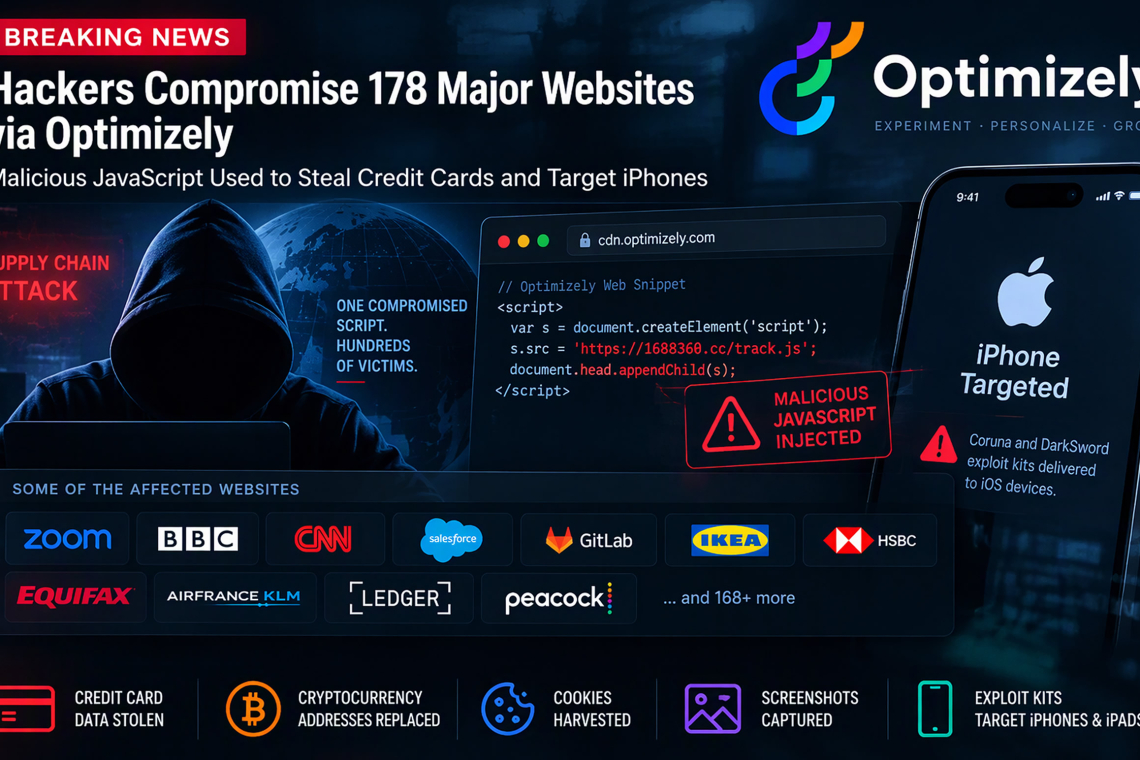
On November 16, 2026, threat actors compromised the Optimizely Web experimentation platform and injected malicious JavaScript that was subsequently delivered to visitors across 178 organizations worldwide.
The campaign impacted a remarkable range of high-profile websites, including those operated by Zoom, BBC, CNN, Salesforce, GitLab, IKEA, HSBC, Equifax, Air France-KLM, Ledger, and Peacock. Security researcher Scott Helme of Report URI uncovered the attack and later confirmed that cybercriminals had already begun profiting from it through cryptocurrency theft. Investigation of blockchain transactions linked the stolen funds directly to wallets under the attackers’ control.Unlike conventional payment-card skimming operations, the malicious code functioned as a sophisticated, multi-purpose attack framework. In addition to replacing cryptocurrency wallet addresses to redirect payments, it harvested credit card information, collected browser cookies, captured screenshots of victim sessions, and delivered the Coruna and DarkSword exploit kits to Apple iPhone and iPad users.
The incident highlights the growing dangers of supply-chain attacks. Rather than breaching hundreds of websites individually, the attackers compromised a trusted third-party service relied upon by all affected organizations. As a result, malicious content was silently distributed through legitimate website code that businesses routinely loaded and trusted.
Attackers Weaponized Optimizely’s JavaScript Infrastructure
Optimizely Web provides experimentation and A/B testing capabilities through a JavaScript snippet loaded from cdn.optimizely.com. This snippet typically contains Optimizely platform code, customer experiments, and an optional feature known as Project JavaScript, which executes before any experiments and can influence behavior across an entire deployment.
The threat actors exploited this capability by inserting a lightweight loader script into the Project JavaScript section while leaving the remainder of the Optimizely code untouched. Because the modified file continued to be delivered from Optimizely’s official infrastructure and was signed with legitimate certificates, browsers and security products generally treated the script as trustworthy.
Analysis of compromised snippets revealed that the injected code quietly generated additional script elements that downloaded malicious payloads from the domain 1688360.cc. In at least one observed example involving Zoom’s implementation, the loader fetched a file named track.js, which served as the attacker's primary malware delivery mechanism.
Cryptocurrency Theft and Payment Card Harvesting
One of the malware's primary capabilities was a cryptocurrency "clipper" component designed to intercept digital asset transfers. The malware continuously scanned web pages for wallet addresses associated with major cryptocurrencies, including Bitcoin, Ethereum, TRON, Solana, TON, Litecoin, Bitcoin Cash, and Dogecoin.
Researchers identified multiple variants of the loader designed to evade detection. One version used straightforward script-loading techniques, while another concealed the attacker-controlled domain through Base64 encoding and JavaScript's atob() function. This simple obfuscation technique helped bypass searches aimed at identifying references to the malicious infrastructure.
A third and more resilient version embedded the full malware payload directly within the compromised snippet. If outbound connections to the attacker’s domain were blocked, the inline code could still execute using JavaScript's eval() function. Investigators also observed evidence that the attackers retained continued access to affected Optimizely projects. In one case, a compromised implementation was cleaned and later reinfected using a different loader variant, indicating persistent unauthorized access.
Even organizations hosting Optimizely snippets from their own domains were not protected. Websites such as Scheels and Vodafone Australia remained vulnerable because the malicious content originated from the same compromised Optimizely project configurations that supplied the code.
When a supported wallet address was detected, the script automatically replaced it with an attacker-controlled address. The manipulation extended beyond webpage content and also targeted clipboard contents and outbound web requests, dramatically increasing the likelihood that victims would unknowingly transfer funds to cybercriminals.
By approximately 19:25 UTC, blockchain analysis showed that attacker wallets had accumulated roughly $7,040 in stolen cryptocurrency. Researchers further observed that the funds were subsequently transferred to cryptocurrency exchanges around 13:03 UTC, suggesting attempts to cash out or launder proceeds.
Later that day, at approximately 13:43 UTC, the attackers expanded their operation by deploying a payment card skimming module. The code monitored web forms for sensitive payment details, including card numbers, expiration dates, and CVV security codes. Collected information was transmitted to a command-and-control endpoint hosted at 1688360.cc/card.php.
The skimmer was effective only against payment forms rendered directly on affected websites. Transactions processed through isolated third-party payment frames, such as those provided by Stripe and Adyen, remained outside the malware’s visibility and were therefore not exposed through this mechanism.
In addition to financial information, the malware collected other valuable data. It transmitted website URLs, accessible browser cookies, and screenshots captured using html2canvas to another attacker-controlled endpoint, 1688360.cc/hit.php, providing operators with both user information and visual records of browsing activity.
iPhone and iPad Visitors Faced Exploit Delivery Attempts
Apple users received special attention within the campaign. When the malware detected an iPhone or iPad, it downloaded a routing component from attacker-controlled .icu domains and selected an exploit chain based on the device’s operating system version.
Devices running iOS 13 through iOS 17 were directed toward the Coruna exploit framework, while systems operating on iOS 18 were targeted with the DarkSword exploit chain. Devices running iOS 26 were not exploited directly but were fingerprinted to gather system information.
According to Google's Threat Intelligence Group (GTIG), the Coruna toolkit incorporates 23 individual exploits organized across five complete attack chains, giving attackers multiple paths to compromise targeted devices. The DarkSword framework similarly leverages six known vulnerabilities affecting iOS 18.4 through iOS 18.7, demonstrating a sophisticated level of offensive capability aimed at Apple ecosystems.
The incident serves as a stark reminder of the risks associated with trusted third-party services. By compromising a single platform used by hundreds of organizations, attackers were able to distribute malware at scale, steal cryptocurrency, harvest payment card data, collect browsing information, and target mobile devices without directly breaching any of the affected websites themselves.
Found this article interesting? Follow us on X(Twitter) ,Threads and FaceBook to read more exclusive content we post.
