
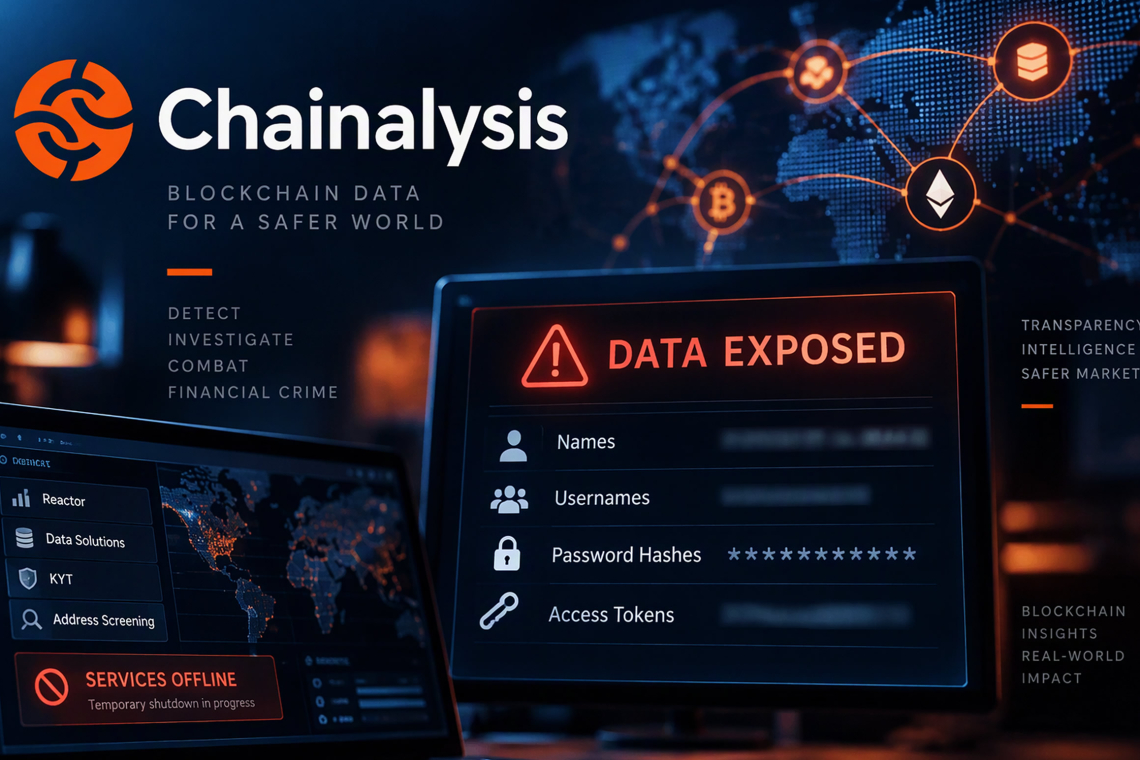
Blockchain intelligence provider Chainalysis has disclosed that its investigation into a sophisticated agentic cyberattack uncovered a far more extensive security incident than initially believed, exposing usernames, names, password hashes, authentication tokens, and other account-related data associated with its user base.
The company announced that, as part of its response efforts, it temporarily suspended access to several core services, including Reactor and Data Solutions, while investigators worked to assess the scope of the compromise and contain any further unauthorized activity.Despite the exposure of user credentials and authentication artifacts, Chainalysis stated that it has not identified evidence indicating that investigative data was accessed or that its proprietary blockchain attribution intelligence was altered. The company noted that safeguarding the integrity of its analytics platform remains a top priority as incident response measures continue.
To strengthen defenses against follow-on attacks, the firm has deployed enhanced monitoring capabilities designed to detect suspicious behavior and anomalous account activity. It also proactively disabled multiple external-facing services, including the Know Your Transaction (KYT) platform, related APIs, address-screening products, and user authentication portals while remediation efforts are underway.Incident Expanded Beyond Initial Findings
Earlier statements from Chainalysis described the event as an active, multi-pronged cyber campaign involving an "on-path" attack mechanism that resulted in the exposure of a subset of customer passwords. Since then, investigators have reportedly mitigated the identified attack vector and expanded the scope of the investigation.
As an additional precaution, affected user accounts have been locked to prevent potential misuse of exposed credentials or authentication tokens.The company warned customers that password-reset functionality remains temporarily unavailable due to the service disruptions. Nevertheless, users were strongly encouraged to immediately change passwords on other platforms where the same credentials may have been reused, reducing the risk of credential-stuffing attacks and account takeovers.
Offensive AI Techniques Allegedly Used
The latest disclosure follows reports issued less than a week earlier indicating that an external threat actor leveraged advanced offensive AI methodologies to gain unauthorized access to internal Chainalysis systems and tooling.
According to the company, restoration efforts are now focused on bringing services back online in a controlled manner. Access to KYT and Address Screening capabilities is expected to resume gradually, with customers required to work directly with support representatives to establish trusted IP addresses for allowlisting before regaining full functionality.Once access is restored, users will be required to reset account passwords, rotate API keys, and implement additional security measures intended to reduce the risk of continued exploitation.
"Our teams are working continuously to reinforce platform security and restore access to critical products," the company stated, adding that stronger account-protection requirements will become mandatory as services return to operation.
Attack Attribution Remains Unknown
At present, investigators have not publicly identified the individuals or groups responsible for the intrusion. However, Chainalysis indicated that the tactics observed share similarities with cyberattacks recently reported across multiple technology providers, suggesting the incident may be part of a broader trend targeting cloud platforms, developer tools, and AI-enabled environments.
Growing Wave of AI-Powered Cyberattacks
The breach arrives amid a significant increase in attacks leveraging autonomous and semi-autonomous artificial intelligence systems. Several technology companies, including Chainstack, OpenCode, Warp, and WorkOS, have recently reported intrusion attempts involving AI-assisted offensive tooling.
Among the tools drawing attention is ARTEX, an autonomous penetration-testing framework capable of discovering exposed credentials, validating access, and conducting follow-up exploitation with minimal human intervention.According to security researchers, modern agentic attack frameworks can automate many stages of the intrusion lifecycle, including reconnaissance, credential discovery, privilege escalation, cloud enumeration, persistence establishment, and data exfiltration.
AI Agents Accelerate Cloud Credential Abuse
Recent threat intelligence has highlighted how attackers are increasingly deploying AI agents to scan public repositories for exposed secrets, including:
- Cloud credentials
- API keys
- Source-code secrets
- OAuth tokens
- AI service credentials
- Infrastructure access keys
- Machine learning platform secrets
Once discovered, these credentials can be rapidly weaponized against cloud workloads and enterprise environments.
Security analysts have documented cases in which autonomous attack agents progressed from identifying exposed secrets in public repositories to extracting sensitive data from cloud resources in only a matter of minutes. In some incidents, attackers reportedly used compromised application credentials to gain access to cloud tenants, enumerate connected resources, and retrieve sensitive organizational data.Observed post-compromise activity has included:
- Accessing cloud storage accounts
- Harvesting application secrets and connection strings
- Extracting publishing credentials
- Enumerating AI and machine learning environments
- Obtaining Kubernetes credentials
- Accessing employee file repositories
- Downloading enterprise documents
- Leveraging compromised AI services for additional malicious operations
AI Infrastructure Emerging as a Criminal Target
Researchers have also observed threat actors targeting AI platforms themselves, not merely as attack tools but as valuable resources that can be monetized.
A growing underground ecosystem has emerged around LLMjacking, a practice in which attackers compromise enterprise AI accounts and abuse them to generate large-scale AI workloads at the victim's expense.Instead of purchasing legitimate access to commercial large language models, criminals increasingly steal API credentials and resell access through intermediary services known as LLM Mixers.
The model effectively transforms compromised enterprise AI subscriptions into underground infrastructure, enabling attackers to distribute requests across multiple stolen accounts, evade attribution, and shift operational costs onto victims.
Financial Impact Continues to Grow
Security experts warn that AI-focused intrusions are no longer limited to espionage or data theft. In many cases, threat actors are targeting organizations specifically to exploit expensive AI resources.
By hijacking cloud-hosted AI services and premium model subscriptions, attackers can generate massive inference workloads that leave victims responsible for substantial cloud and API charges. Some incidents have reportedly resulted in organizations accumulating hundreds of thousands of dollars in unexpected AI-computing expenses before unauthorized usage was detected and contained.Found this article interesting? Follow us on X(Twitter) ,Threads and FaceBook to read more exclusive content we post.
