
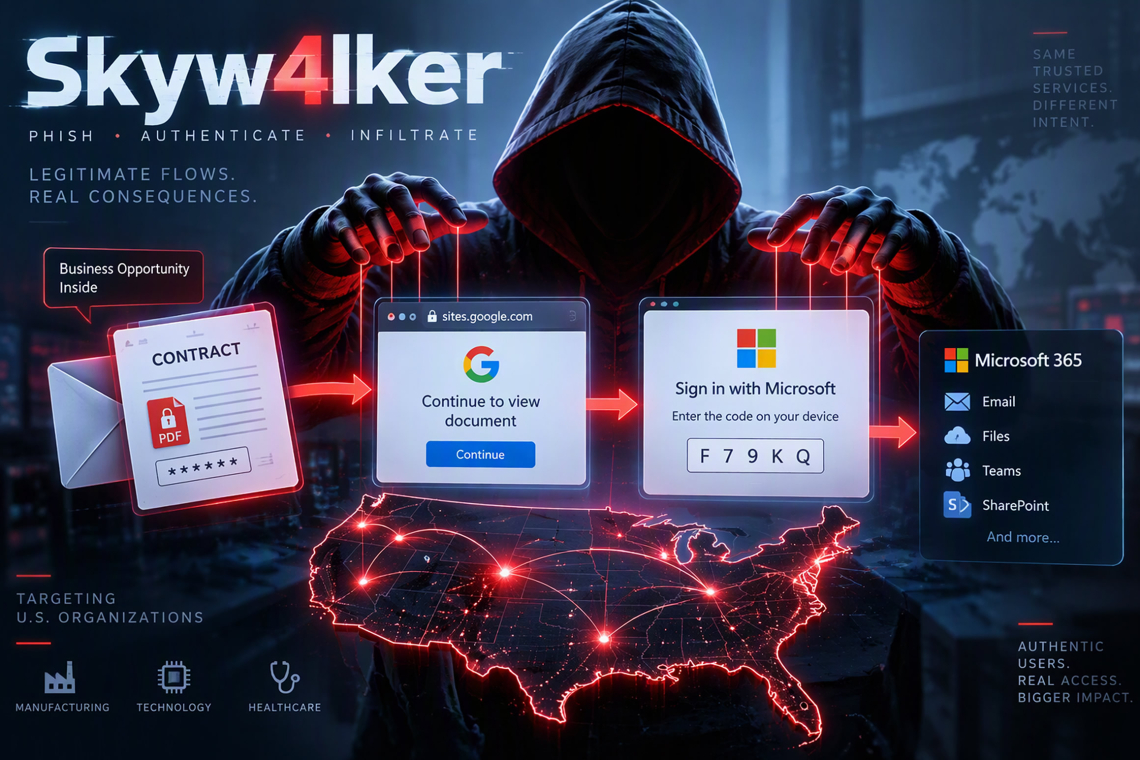
Modern phishing attacks are evolving beyond traditional credential theft, allowing threat actors to compromise corporate accounts without stealing usernames or passwords. By abusing trusted cloud platforms, legitimate authentication workflows, and commonly used business processes, attackers can gain unauthorized access while leaving behind far fewer indicators of compromise.
A recent analysis by ANY.RUN uncovered the Skyw4lker device code phishing operation, a campaign primarily aimed at organizations across the United States. The threat actors have concentrated their efforts on the manufacturing, technology, and healthcare sectors, leveraging business-related documents, Google-hosted infrastructure, and legitimate Microsoft authentication mechanisms to facilitate account takeovers.
For security teams, investigating campaigns like Skyw4lker requires more than simply identifying a phishing email or malicious document. Analysts must follow the entire attack chain, correlate authentication events with supporting infrastructure, extract actionable indicators of compromise (IOCs), and transform those findings into effective detection mechanisms.
Device Code Phishing Emerges as a Significant Threat
The threat landscape continues to be dominated by phishing. As organizations strengthen identity security controls and deploy multifactor authentication (MFA), attackers have adapted their techniques to bypass conventional defenses.
Device code phishing represents one such evolution. Instead of directing victims to counterfeit login portals designed to steal credentials, attackers exploit legitimate device authorization workflows. Victims are tricked into approving authentication requests initiated by adversaries, ultimately granting access tokens that can be used to access Microsoft 365 resources and other connected services.
Because these authentication events occur through valid Microsoft processes, traditional identity monitoring may only see what appears to be a legitimate login. Without additional context, detecting malicious intent becomes significantly more challenging.
Inside the Skyw4lker Attack Chain
The campaign begins with convincing business-themed lures crafted to resemble legitimate corporate communications.
Victims receive password-protected files disguised as contracts, partnership agreements, procurement documentation, service proposals, or similar business records. These documents appear credible, particularly in organizations where employees routinely exchange vendor agreements and project-related paperwork.
Upon opening the document, targets are directed to a webpage hosted through Google Sites, which then initiates a Microsoft authentication process. Unlike conventional phishing campaigns, attackers do not need to recreate Microsoft's login interface or trick users into entering passwords.
Instead, victims unknowingly complete an authentication process generated by the attacker. Once approved, Microsoft 365 authentication tokens are issued and can be leveraged to access the victim's account and associated resources.

This technique makes forensic analysis more difficult because the authentication event itself appears valid. Understanding the compromise requires correlating multiple data points, including document activity, browser interactions, redirects, and authentication logs.

Phishing Infrastructure Built on Legitimate Services
ANY.RUN's investigation revealed a sophisticated supporting infrastructure behind the campaign.
Researchers observed obfuscated JavaScript code and a PHP-based backend designed to:
- Establish victim sessions
- Collect IP addresses and geolocation data
- Monitor authentication progress
- Continuously communicate with backend servers during the attack
While static analysis may uncover an initial URL embedded within a document, it cannot fully expose the attack's behavior. The malicious activity only becomes apparent when analysts observe browser execution, web redirects, JavaScript activity, server communications, and authentication workflows operating together.
This highlights the importance of dynamic behavioral analysis when assessing advanced phishing threats.
Why Interactive Sandboxing Matters
Interactive sandbox environments provide security teams with the ability to safely execute suspicious files, documents, and URLs while observing their behavior in real time.
In campaigns like Skyw4lker, the document itself represents only the first stage of the attack. Analysts must trace browser activity, inspect network communications, monitor redirects, and identify supporting infrastructure to fully understand the threat.
Using an isolated sandbox environment, investigators can quickly generate:
- Malicious URLs
- Domains and IP addresses
- Network traffic indicators
- Screenshots and behavioral evidence
- Authentication flow observations
- Additional indicators of compromise

Rather than simply determining whether a file is malicious or benign, analysts gain actionable intelligence that can be used for incident validation, threat hunting, and detection engineering.
Transforming Threat Intelligence into Faster Detection
The value of an IOC extends beyond a single investigation when it can help identify future attacks.
Threat intelligence feeds containing validated malicious domains, URLs, and IP addresses allow organizations to proactively detect known threats before analysts manually investigate every alert. Previously observed indicators can be automatically matched against customer telemetry, accelerating incident response and reducing investigative workload.
This creates a more efficient workflow in which:
- Known malicious activity is identified earlier.
- Analysts focus on new and emerging threats.
- Detection teams improve visibility across the environment.
- Threat intelligence becomes reusable across multiple investigations.

For managed security service providers (MSSPs), intelligence collected from one customer's incident can often help uncover related activity affecting others. Internal SOC teams benefit similarly by searching newly discovered indicators across historical logs and enterprise telemetry.
Adding Context to Indicators
Raw indicators become significantly more valuable when security teams can understand their broader context.
Threat intelligence platforms enable analysts to investigate domains, URLs, and IP addresses while examining associated infrastructure, historical activity, and campaign relationships. This context helps determine whether an indicator is tied to a specific operation such as Skyw4lker or forms part of a much larger threat ecosystem.
Threat intelligence reporting can also uncover:
- Shared attacker infrastructure
- Related phishing campaigns
- Common tactics and procedures
- Connections between seemingly isolated incidents
For healthcare, manufacturing, and technology organizations, these insights are particularly important because compromised Microsoft 365 accounts may expose sensitive communications, intellectual property, operational data, and regulated information.
Maximizing the Value of Every Investigation
An effective investigation should strengthen an organization's defenses beyond the immediate incident.
For example, indicators discovered during a phishing investigation involving a manufacturing company can be immediately searched across other business units, customers, or environments. What begins as a single user compromise can ultimately reveal a broader campaign affecting multiple targets.
Through integrations with SIEM, XDR, TIP, STIX/TAXII, and API-based workflows, threat intelligence generated during an investigation can be incorporated directly into existing monitoring and detection systems.
The result is greater visibility, improved detection capabilities, and a stronger security posture across the entire organization.
Conclusion
The Skyw4lker campaign demonstrates how modern phishing operations increasingly rely on legitimate authentication mechanisms rather than credential theft alone. By exploiting trusted Microsoft and cloud-based workflows, attackers can gain access while evading traditional detection methods.
Organizations can improve their resilience by combining behavioral analysis, interactive sandboxing, threat intelligence, and contextual investigations. This approach enables security teams to move quickly from suspicious artifacts to actionable intelligence, improving both immediate incident response and long-term detection capabilities.
Ultimately, the objective is not simply to stop a single phishing attempt but to ensure that every investigation contributes intelligence that helps prevent the next attack.
Found this article interesting? Follow us on X(Twitter) ,Threads and FaceBook to read more exclusive content we post.
