
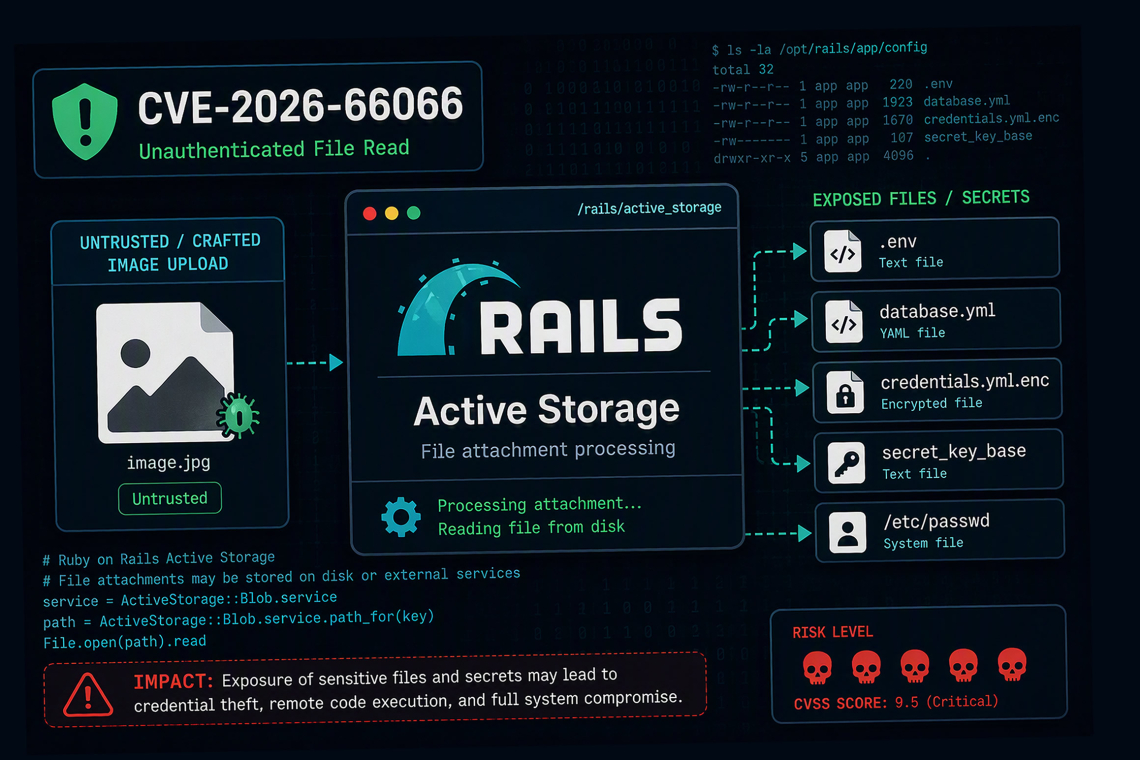
The Ruby on Rails team has released security updates to address a critical vulnerability in Active Storage that could enable unauthenticated attackers to read arbitrary files from affected application servers simply by uploading specially crafted image files.
Tracked as CVE-2026-66066 and assigned a CVSS severity score of 9.5, the vulnerability poses a serious risk because it can expose highly sensitive information stored on Rails servers. Attackers may be able to access environment files, application secrets, encryption keys, database credentials, cloud storage access keys, and API tokens. If these secrets are compromised, they could be leveraged to achieve remote code execution (RCE), escalate privileges, or pivot into connected systems and cloud environments.
Who Is Affected?
The issue impacts Rails applications that:
- Use Active Storage for handling file uploads.
- Rely on libvips for image processing.
- Accept uploads from untrusted or external users.
Rails 7 and newer versions typically default to the Vips image-processing backend, making many modern deployments potentially vulnerable without additional configuration.
According to security researchers, the following versions are affected:
- Rails 7.0.0 through 7.2.3.1
- Rails 8.0.0 through 8.0.5
- Rails 8.1.0 through 8.1.3
Rails 6.x installations may also be vulnerable if Active Storage has been manually configured to use Vips rather than the older default image processor.
Applications that use MiniMagick instead of Vips are not vulnerable through this specific attack path.
Organizations still operating on Rails 7.0 or 7.1 should take particular notice, as those branches have reached end-of-life status and will not receive security fixes. Upgrading to a supported release is required to mitigate the risk.
Root Cause of the Vulnerability
The flaw exists at the intersection of Active Storage and libvips.
Libvips supports a wide range of image-processing features, including loaders, writers, converters, and integrations with third-party libraries. Some of these capabilities are considered unsafe when processing untrusted user input.
Researchers discovered that Active Storage failed to adequately restrict access to certain libvips operations designated as "untrusted" or insufficiently hardened. As a result, a maliciously crafted image upload could trigger file-reading behavior within the application's security context.
This allowed attackers to access any files readable by the Rails application process.
Importantly, exploitation does not require an application to expose thumbnail generation, image resizing, or other visible image-processing features. Simply uploading a crafted image may be sufficient because both Active Storage's analyzer and transformation workflows can invoke the vulnerable functionality.
Potential Impact
Successful exploitation grants attackers an arbitrary file-read capability.
Depending on what information is exposed, attackers could obtain:
secret_key_base- Rails master keys
- Encrypted credentials
- Database usernames and passwords
- Active Storage service credentials
- Cloud provider access keys
- Third-party API tokens
- Environment configuration files
While the vulnerability itself does not directly execute code, access to these secrets could allow attackers to compromise databases, cloud infrastructure, or application environments and potentially achieve full system takeover.
Security experts warn that the exposure of application credentials can also facilitate lateral movement into connected systems and services.
Available Security Fixes
Ruby on Rails has released patched versions:
- Rails 7.2.3.2
- Rails 8.0.5.1
- Rails 8.1.3.1
In addition to updating Rails, administrators must ensure:
- libvips 8.13 or later is installed.
- ruby-vips 2.2.1 or later is used when applicable.
The remediation introduces a new protection mechanism that blocks unsafe libvips operations automatically when Active Storage initializes.
Additional Steps Required After Patching
Applying the update alone may not be sufficient.
If a vulnerable system may have been exposed before patching, administrators should assume that sensitive credentials could already have been accessed. Security teams are strongly encouraged to rotate all secrets available to the Rails process, including:
secret_key_base- Rails master keys
- Database passwords
- Cloud storage credentials
- Active Storage service keys
- API tokens
- Third-party authentication secrets
Failure to rotate exposed credentials could leave organizations vulnerable even after software updates have been applied.
Temporary Mitigations
Organizations unable to upgrade immediately can implement temporary protections if running supported versions of libvips.
Options include:
- Setting the
VIPS_BLOCK_UNTRUSTEDenvironment variable. - Explicitly invoking:
However, these mitigations require:
- libvips 8.13 or newer
- ruby-vips 2.2.1 or newer
Older libvips versions do not support these protections, making upgrades the preferred and recommended solution.
Current Exploitation Status
As of July 29, 2026, security researchers had not publicly released a proof-of-concept exploit, and no publicly indexed exploit code had been identified in major repositories such as GitHub, GitLab, Exploit-DB, or Packet Storm.
Nevertheless, the severity of the vulnerability and the simplicity of the attack path make rapid patching critical. Organizations should prioritize remediation immediately, especially if their applications accept image uploads from external users.
Conclusion
CVE-2026-66066 represents one of the most serious Ruby on Rails vulnerabilities disclosed in 2026. By abusing weaknesses in Active Storage's integration with libvips, attackers can potentially access sensitive server-side files without authentication, exposing credentials that may lead to complete application or infrastructure compromise. Organizations running affected Rails deployments should patch immediately, upgrade supporting libraries, and rotate all potentially exposed secrets to reduce the risk of further exploitation.
Found this article interesting? Follow us on X(Twitter) ,Threads and FaceBook to read more exclusive content we post.
