
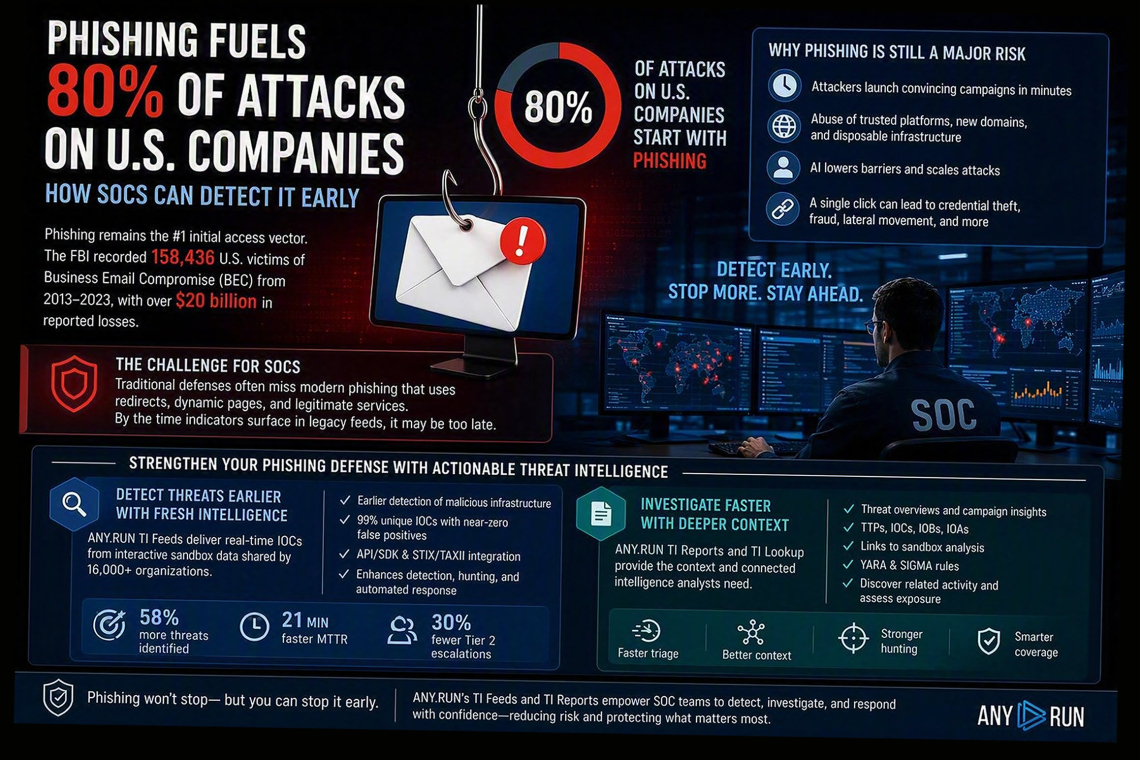
Phishing remains one of the most successful techniques cybercriminals use to infiltrate corporate environments. Between 2013 and 2023, the FBI recorded more than 158,000 U.S. victims of Business Email Compromise (BEC), resulting in reported losses exceeding $20 billion.
Federal authorities continue to warn that phishing campaigns are a primary method for stealing corporate credentials and gaining unauthorized access to business networks.
Despite significant investments in secure email gateways, endpoint protection platforms, and employee awareness programs, organizations continue to face an unrelenting wave of phishing attacks. Threat actors have evolved their tactics, leveraging compromised infrastructure, trusted cloud services, redirect chains, dynamic phishing pages, and advanced social engineering techniques to evade traditional defenses.
For SOC leaders and CISOs, the challenge is clear: How can organizations identify and stop phishing attacks before they lead to compromise?
The answer lies in actionable threat intelligence. By combining fresh indicators of compromise (IOCs) with analyst-curated intelligence on active phishing campaigns, security teams can improve detection accuracy, accelerate investigations, and shift from a reactive to a proactive security posture.
Why Phishing Continues to Threaten U.S. Businesses
Phishing has always been a significant cybersecurity risk, but the threat landscape has become increasingly sophisticated.
Today, attackers can launch convincing phishing campaigns within minutes using newly registered domains, disposable infrastructure, trusted platforms, and highly targeted lures tailored to specific organizations or individuals. The rise of AI has further lowered the barrier to entry, enabling cybercriminals to create professional-looking phishing content at scale.
For security operations teams, phishing is no longer just an email security issue. A single compromised credential can trigger a chain of events that includes account takeover, lateral movement, financial fraud, data theft, and additional phishing activity.
The sooner security teams identify and disrupt the infrastructure supporting these campaigns, the greater their chances of preventing a security incident.
Taking a Proactive Approach to Modern Phishing
Many security controls still depend heavily on reputation-based detection, historical indicators, and static analysis. While these methods remain valuable, they often struggle to detect modern phishing campaigns that rely on newly created infrastructure, legitimate redirection services, and dynamically generated phishing content.
By the time malicious indicators appear in traditional threat feeds, they may already be stale or lack the context analysts need to evaluate risk effectively.
For SOC leaders, success is no longer about collecting more threat data. Instead, it requires access to timely, validated, and actionable intelligence that can be operationalized immediately.
Moving from Reactive Response to Preventive Defense
Threat intelligence strengthens every stage of the phishing defense lifecycle, from early detection and investigation to hunting and response.
Detect Emerging Threats Earlier with Fresh Intelligence
One of the most effective ways to disrupt a phishing campaign is to identify malicious infrastructure before it can successfully compromise users.
Achieving this requires access to intelligence that reflects newly observed threats rather than relying solely on historical indicators.
ANY.RUN Threat Intelligence Feeds (TI Feeds) provide SOC teams with visibility into emerging threats, including phishing operations, malware campaigns, and zero-day exploitation activity.
These feeds deliver fresh malicious IP addresses, domains, and URLs enriched with contextual data derived from Interactive Sandbox investigations conducted by more than 16,000 organizations worldwide.

Designed to provide 99% unique indicators with near-zero false positives, TI Feeds offer high-confidence intelligence generated from real-world malware and phishing investigations.
For security teams, this delivers several operational advantages:
- Earlier Detection: Recently identified indicators help uncover malicious infrastructure before an attack progresses.
- High-Confidence Intelligence: Context-rich indicators validated through sandbox analysis reduce noise and increase analyst confidence.
- Automation at Scale: Integration through APIs, SDKs, and STIX/TAXII enables seamless deployment into existing security workflows.
- Improved Security Operations: Organizations can enhance detection, alerting, correlation, threat hunting, and automated blocking, leading to faster response times and reduced analyst workload.
By operationalizing intelligence in this way, threat intelligence becomes more than a research tool. It becomes a continuously updated source of detection and prevention data across the SOC.
Accelerating Triage with Better Context
Even mature security programs should expect some phishing activity to evade preventive controls and require investigation.
Consider recent phishing campaigns that leveraged adversary-in-the-middle (AiTM) techniques and sophisticated credential-harvesting infrastructure to target tens of thousands of users, particularly across the United States.
When suspicious activity is detected, analysts must quickly determine whether it is connected to a known campaign, threat actor, or malicious infrastructure. They also need visibility into associated indicators, adversary techniques, and potential detection opportunities.
Without sufficient context, investigations often become time-consuming and resource-intensive. Analysts may need to examine indicators individually, consult multiple intelligence sources, and manually reconstruct attack chains, increasing the burden on both Tier 1 and Tier 2 teams.
Turning Intelligence into Actionable Insights
Threat Intelligence Reports provide a broader perspective than standalone indicators.
ANY.RUN TI Reports deliver expert-curated research on the latest phishing campaigns, malware strains, advanced persistent threat (APT) activity, and other cyber threats. These reports include:
- Threat overviews and campaign analysis
- Targeted industries and geographic regions
- Tactics, Techniques, and Procedures (TTPs)
- Indicators of Compromise (IOCs)
- Indicators of Behavior (IOBs)
- Indicators of Attack (IOAs)
- Links to supporting sandbox analyses
- Detection content, including YARA and SIGMA rules

In addition, Threat Intelligence Lookup (TI Lookup) allows analysts to investigate related activity, identify connected indicators, and proactively assess organizational exposure.
Together, these capabilities transform raw threat data into practical intelligence that enhances detection engineering, threat hunting, and incident response operations.
Conclusion
Modern phishing attacks are increasingly sophisticated, adaptive, and difficult to distinguish from legitimate activity. As a result, organizations face growing risks of credential theft, financial fraud, account compromise, and data loss.
By combining fresh threat indicators with expert-curated intelligence, ANY.RUN's TI Feeds and TI Reports help SOC teams detect threats sooner, investigate incidents more efficiently, and conduct more effective threat hunting activities. Organizations that integrate actionable threat intelligence into their daily security operations can respond with greater speed and confidence while significantly reducing the overall impact of phishing attacks.
Found this article interesting? Follow us on X(Twitter) ,Threads and FaceBook to read more exclusive content we post.
