
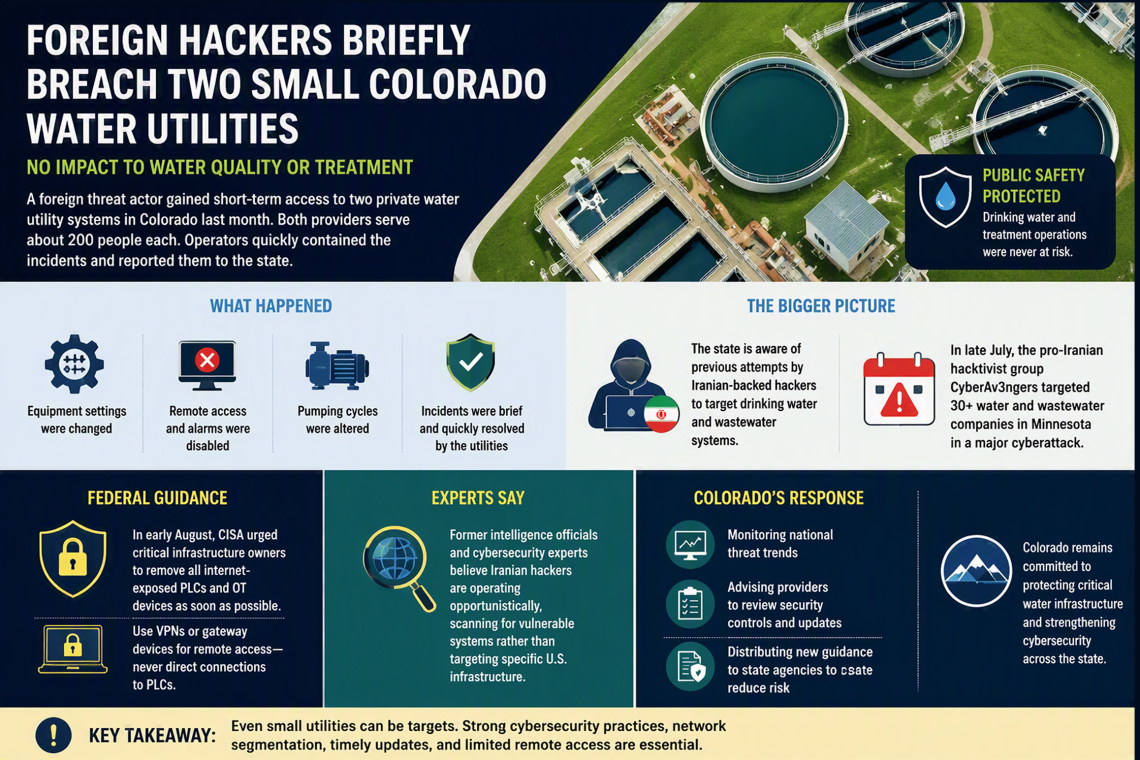
A foreign cyber threat actor briefly infiltrated the systems of two small water utility providers in Colorado last month, raising fresh concerns about the cybersecurity of critical infrastructure. While the incidents involved unauthorized access to operational technology, state officials emphasized that neither drinking water quality nor the treatment process was ever compromised.
Both affected utilities are privately owned and serve relatively small communities of roughly 200 residents each. According to state authorities, the intrusions were quickly detected and contained before they could cause significant disruption or public safety concerns.
Officials said the attackers manipulated several operational settings within the utilities' management systems, including modifying equipment configurations, disabling remote access capabilities and alarm functions, and altering pumping schedules. Fortunately, utility operators identified the unauthorized changes promptly, restored normal operations, and reported the incidents to state authorities.
A spokesperson for Colorado Governor Jared Polis noted that the events were short-lived and effectively mitigated by the affected providers, preventing any impact on water delivery or quality.
Concerns Over Foreign Cyber Activity
Although state officials have not publicly attributed the attacks to a specific group, they acknowledged growing concerns surrounding foreign actors targeting water and wastewater infrastructure across the United States. Authorities pointed to previous campaigns linked to Iranian-backed hackers that have focused on vulnerable industrial control systems and internet-connected utility equipment.
The incidents in Colorado follow a broader trend of cyber operations aimed at critical infrastructure organizations, particularly smaller utilities that may have limited cybersecurity resources and aging operational technology environments.
Growing Threat to Water Infrastructure
The attacks occurred only weeks after the pro-Iranian hacktivist group CyberAv3ngers reportedly targeted more than 30 water and wastewater organizations in Minnesota during a coordinated campaign that officials described as one of the largest cyber incidents ever directed at the state's water infrastructure.
In response to those attacks, Minnesota IT Services worked alongside the Minnesota Department of Public Safety, the FBI, and other federal agencies to assist affected communities and strengthen the resilience of critical infrastructure networks.
Security experts have repeatedly warned that water utilities, energy providers, and other industrial organizations remain attractive targets because of their reliance on operational technology systems that were often not designed with modern cybersecurity threats in mind.
Federal Agencies Urge Immediate Security Measures
Following the rise in attacks against critical infrastructure, the U.S. Cybersecurity and Infrastructure Security Agency (CISA) issued guidance urging organizations to remove publicly exposed programmable logic controllers (PLCs) and other operational technology devices from direct internet access.
CISA recommends that any remote operational access be routed through secure gateways or virtual private networks (VPNs) rather than allowing direct connectivity to industrial control equipment. Doing so significantly reduces the attack surface available to cyber adversaries seeking unauthorized access.
Cybersecurity specialists have also noted that many recent infrastructure intrusions appear to be opportunistic rather than highly targeted. Threat actors frequently scan the internet for exposed devices and known vulnerabilities, exploiting easily accessible systems regardless of their geographic location or organizational profile.
Colorado Strengthens Defensive Posture
In light of the recent incidents, Governor Polis' administration is closely monitoring nationwide cyber threats targeting utility providers and recommending that Colorado organizations review security controls, software updates, network segmentation, and remote-access configurations.
State officials have begun distributing updated cybersecurity guidance to agencies and utility operators aimed at reducing the risk of future breaches. The recommendations include strengthening authentication controls, limiting internet exposure of operational systems, improving monitoring capabilities, and ensuring timely application of security updates.
The incidents serve as another reminder that even small utilities can become targets for foreign cyber actors. While the Colorado breaches were contained without affecting public health or water services, they underscore the importance of proactive cybersecurity measures across critical infrastructure sectors where even brief unauthorized access can create significant operational risk.
Found this article interesting? Follow us on X(Twitter) ,Threads and FaceBook to read more exclusive content we post.
